
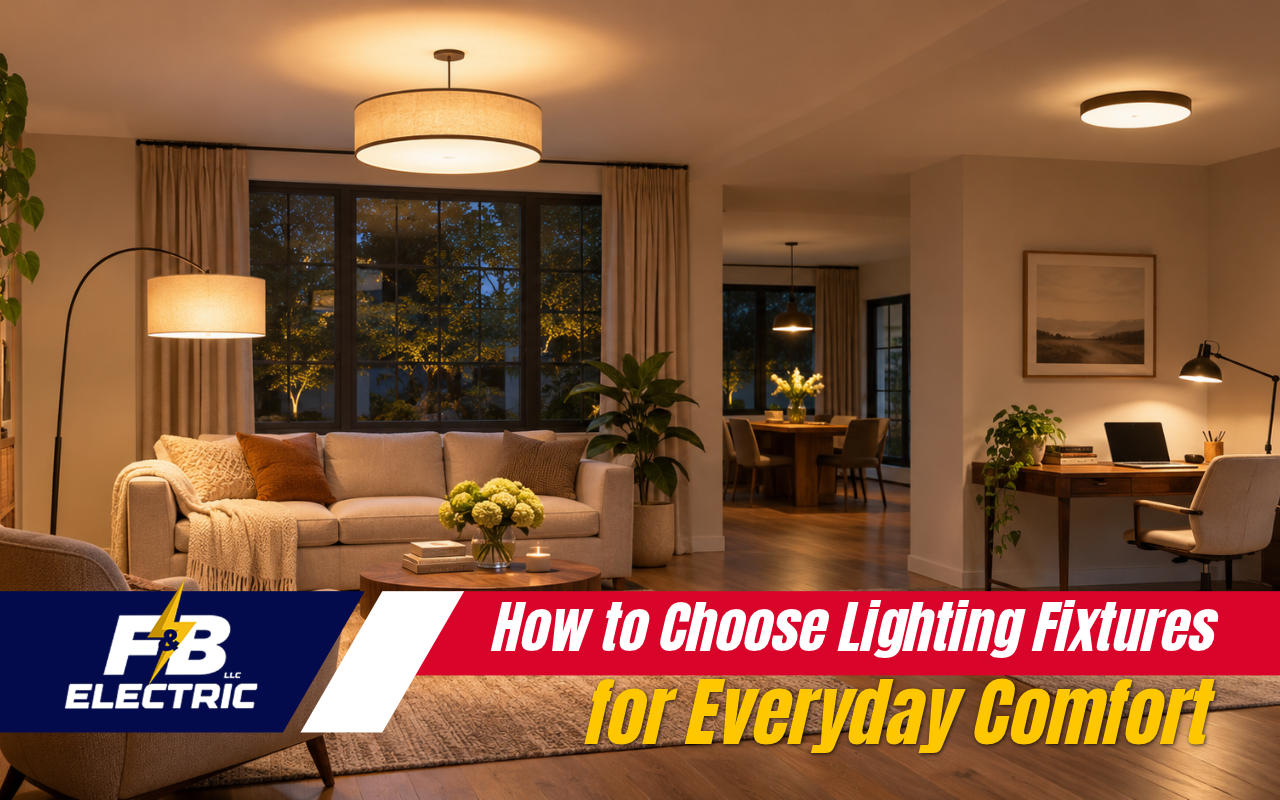
Learning how to choose lighting fixtures starts with the room’s daily tasks. A fixture can look attractive and still leave the counter dark or create glare at your desk. At F&B Electric LLC, we bring more than 20 years of experience to electrical work. For lighting fixture installation in Ellicott City, MD, Discuss Your Lighting Goals.
Map Activities Before Browsing Fixture Styles
Walk through the room and list what happens in each area. Reading, preparing food, dressing, and watching television create different lighting needs. Mark the places where someone stands or sits during those activities. This simple map makes placement decisions more concrete.
Next, identify the current frustration. Perhaps the main light leaves a shadow over the sink. Maybe a bedside lamp makes nighttime movement awkward. Describing the problem helps you decide whether to change the fixture, add a separate light source, or revise the controls.
Match Fixture Types to the Job
| Fixture type | Useful role | Planning question |
|---|---|---|
| Flush or surface-mounted ceiling light | General room illumination | Does the room need additional task lighting? |
| Pendant | Focused light over a defined area | Will the height preserve sightlines and clearance? |
| Wall sconce | Local light near a wall or seating area | Will the position create glare for a seated person? |
| Under-cabinet light | Task light across a counter | Will the source remain comfortable to view? |
| Recessed downlight | Directed illumination from the ceiling | Does the ceiling construction suit the installation? |
These lighting fixture types are tools, not complete room designs. A single decorative fixture may not serve every task. Compare the light distribution as well as the appearance when deciding which combination supports the room.
Sketch Placement Around People and Furniture
Indoor lighting fixture placement works best when it follows the room’s layout. Mark tables, work surfaces, and seating before choosing mounting points. To discuss how those positions translate into electrical work, Plan Your Fixture Placement.
Imagine the light path during a typical task. A person standing between a ceiling light and a counter can cast a shadow across the work area. A separate task source may solve that problem more effectively than a brighter ceiling fixture.
Check the plan from different viewing heights. A pendant that looks comfortable while standing may place a bright source directly in a seated person’s view. Make a simple paper outline of the fixture size to judge its visual weight before purchasing.
Furniture Changes Affect Mounting Points
Leave room for furniture changes where practical. If the dining table may move, explain that during planning. A fixed ceiling position should reflect likely use rather than a temporary layout chosen during a renovation.
Check Light Output at Different Times
Lumens describe light output; watts describe power use. Color temperature describes whether white light appears warmer or cooler. These measures answer different questions, so a higher wattage label does not replace a brightness comparison.
Include daylight in the map, but plan for evening use too. A bright window at noon does not solve a dark work surface after sunset. Consider curtains, furniture, and the direction people face when they use the room.
Compare samples in the actual room when possible. Wall colors, reflective surfaces, and shades can change how the light feels. A fixture with a dark shade may distribute light differently from a similarly sized fixture with a translucent diffuser.
Open Rooms Need Consistent Light Color
Think about adjoining spaces too. Large shifts in color appearance can feel distracting when rooms share an open view. You can choose different task effects without creating an unplanned patchwork of visibly different white light.
Installation Compatibility Comes Before Checkout
Our team at F&B Electric LLC is licensed and insured. Before ordering fixtures with unusual electrical requirements, discuss the specifications and the existing installation conditions with an electrician.
Ceiling light fixture installation depends on more than matching two wires. The electrical box, support arrangement, wiring condition, and fixture instructions matter. A heavy fixture may need a different support solution from the light it replaces.
- Check the fixture’s size and weight.
- Confirm its rating for the intended location.
- Review whether the existing electrical box suits the installation.
- Ask about access above or behind the mounting surface.
- Clarify whether wall or ceiling repair belongs in the scope.
Do not assume an existing ceiling opening establishes suitable support. Likewise, a bathroom location may need equipment rated for the specific exposure. Give the installer the product instructions before finalizing the purchase.
Controls Should Support Daily Routines
A dimmer can make one lighting arrangement more flexible, but the dimmer and light source need compatible specifications. Check the manufacturer’s compatibility guidance. A dimmable label alone does not establish compatibility with every existing dimmer.
Consider which lights should operate together and which need separate control. Someone preparing food may want task lights without every decorative fixture on. A bedroom may need an easy control point near both the entrance and the normal sleeping area.
Maintenance Access Belongs in the Selection
Also ask how you will maintain the selected fixture. A light above a stairwell may create a different access problem from one in a hallway. Compare replaceable lamps with integrated light sources, and read the manufacturer’s service information. Keep the product details so a future replacement does not depend on remembering the original model.
Use a Final Checklist Before Ordering
Confirm the task, location, brightness, color appearance, mounting needs, and control compatibility for every selected fixture. Keep model numbers and installation instructions together. At F&B Electric LLC, we offer a free estimate for proposed electrical work.
Choose a lighting plan that makes everyday activities easier and leaves the installation requirements clear. If efficient lighting forms part of that plan, Explore Efficient Lighting Options.